Can Bleeding in the Brain Happen Again When You Push Yourself to Hard
Dr. Evan Cohn studied radiology at the University of Virginia Health System. Years afterward, his life was saved by the UVA radiologists that helped railroad train him. Larn more virtually Dr. Cohn's SAH experience and recovery, and read the comments to hear about other people's SAH journeys. You can share your feel past scrolling to the very bottom of the folio and inbound your annotate in the comment box.
An Update from Dr. Cohn, 9/i/21: Curl to the bottom of the article to read about how Dr. Cohn is doing nearly six years later his subarachnoid hemorrhage.
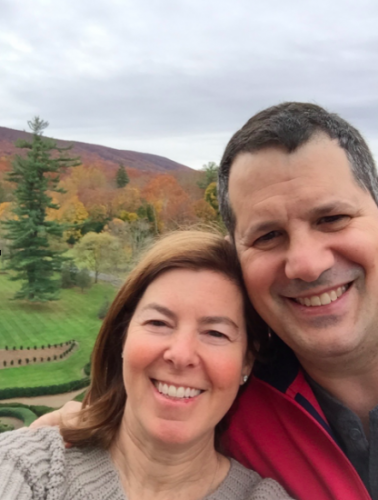
Dr. Evan Cohn and his wife Amy at The Homestead Resort
In October 2015, Evan Cohn and his wife Amy were on vacation at The Homestead Resort in Hot Springs, VA. They took a selfie showing broad smiles and a beautiful Virginia landscape in the background.
One hr later on, Dr. Cohn began suffering from a astringent headache, nausea, and sweating. Inside xv minutes of these symptoms, he was on his way to the Bath County Emergency Room.
A CT of the head showed a subarachnoid hemorrhage (bleeding between the two membranes that environs the encephalon), and staff immediately prepared him for a helicopter ride to UVA Health's main infirmary in Charlottesville.
An Incredible Series of Events
Equally a doctor, Dr. Cohn knew his status was serious. From 1993-1998, he had studied at UVA Radiology and Medical Imaging, completing his residency and musculoskeletal fellowship. When he finished the plan, he began piece of work at the Presbyterian Hospital of Dallas in Dallas, Texas.
The series of events was incredible. Dr. Cohn happened to be vacationing in Virginia and was sent to the very hospital where he had studied to get a radiologist. He still knew other radiologists who worked there. On his was to UVA, he texted Dr. Mark Anderson, one UVA radiologist he knew from his residency days.
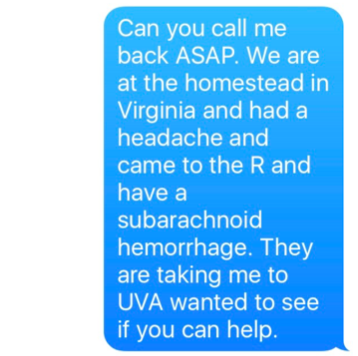
Dr. Cohn'south text to Dr. Mark Anderson, radiologist at UVA

UVA Health'south Pegasus helicopter
Dr. Anderson called and told him that Dr. Lee Jensen and Dr. Avery Evans, both neurointerventional radiologists, were at the hospital and were prepare for him. "Information technology was a comfort to me to know I was going to UVA and that I was in very skilful hands," said Dr. Cohn. "Dr. Jensen and Dr. Evans were both there when I was a resident and they are fantabulous physicians."
Later on this, he remembers a nurse asking to pray with him and and then waiting for the helicopter to take off, wondering if he would always see his family over again. After that, his retentivity is blank. He doesn't remember the two weeks he spent at the UVA Infirmary, the anxiety that his wife and daughters endured, or the doctors and nurses who cared for him during his stay.
Recovery and a New Normal
The time following his release from the infirmary was difficult. In Nov of 2015, a month after the hemorrhage, he started attending a year-long rehabilitation programme for half dozen.5 hours a solar day. He supplemented the rehab with his ain efforts to relearn Spanish and past playing games like Rummikub as well as encephalon games on his telephone and computer.
Today, Dr. Cohn says he has a new normal. He gets fatigued hands and doesn't think details well. He all the same gets sporadic headaches. He's had to adjust his life habits. But since the beginning, his family has surrounded him with incredible support and beloved.
While Dr. Cohn has always been a positive person with a positive outlook on life, this life-irresolute result strengthened this trait of his. "I'g lucky to be alive," he said. "I found out after that l% of people with the same diagnosis don't make it." The hemorrhage made him realize that he doesn't know the end of his story–no one does. "You don't know what's going to happen on whatsoever given day, and yous should enjoy every twenty-four hour period to the fullest," he said. "Now, every night I go through what I am satisfied with, what I've enjoyed, what I'm thankful for, and what I am hopeful for that 24-hour interval."
To those who have experienced a subarachnoid hemorrhage, Dr. Cohn encourages them: "What you're going through is normal. Recovery is long and hard. Most importantly, it'southward private."
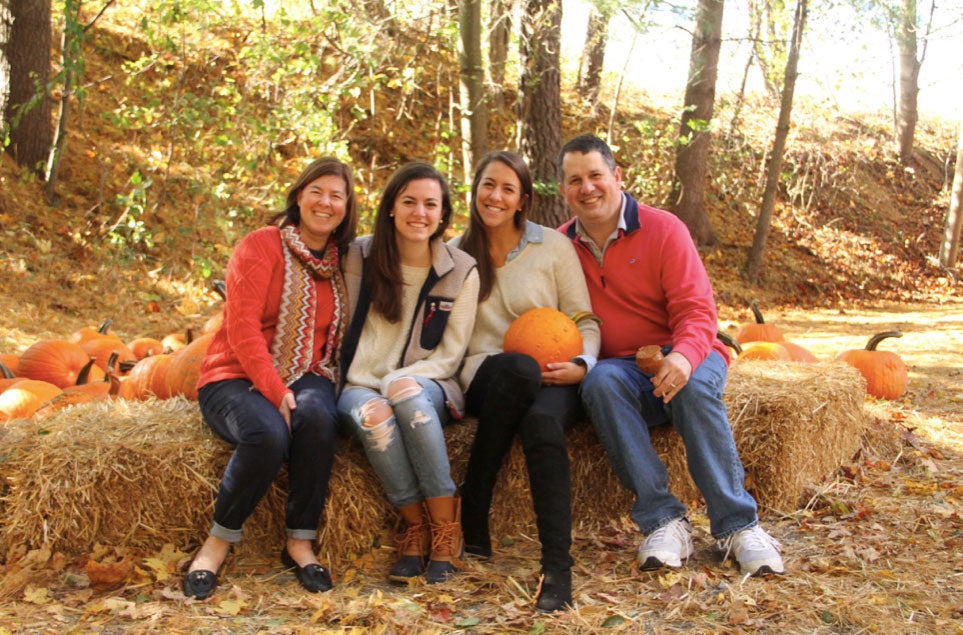
Dr. Cohn kept going dorsum to his family unit and how incredible they are. "It's been a definite change for everybody," he said. "I appreciate my family and am then thankful for them. Amy, his wife, chimed in and said, "It'south a expert lesson to honey your family and capeesh them while they're here." Dr. Cohn agreed, "I feel grateful everyday. I have realized the preciousness of life."
September 2021: An Update from Dr. Evan Cohn
Evan Cohn spoke with us in the summer of 2022 to give us an update almost his life half dozen years after a subarachnoid hemorrhage. He's pleased that his original commodity has resonated with and so many people. "My promise is that sharing what I went through and what has helped me can help others," he says. "And I'm very glad that the comment section has been a place for people to connect and see that they are not solitary."
Evan Cohn'south life looks very unlike than it did six years ago. Staying healthy, functional and present requires daily, ongoing endeavour from him and his family. That starts with simple things, like getting enough rest every night, or writing everything down–appointments, tasks, lists–to help him remember to do them.
Dr. Cohn had to leave his medical practise equally a radiologist because of connected fatigue and cerebral issues after his subarachnoid hemorrhage. Physicians are instructed to 'Exercise No Harm,' and he knew that mistakes he would make in his work interpreting medical images could be mortiferous for his patients.
Simply not being released to become back to work equally a physician was more impactful than only giving upward a job: it meant letting go of his identity as a physician. That required a broader credence of what his life is now, versus what he imagined for himself before his hemorrhage.
And just equally letting become of his identity as a physician was hard, so too was accepting a new identity as a survivor. He struggles with knowing exactly how to talk almost it and share without overdoing it.
Making Changes to Make Life Piece of work
Today, Evan continues to feel fatigue, headaches, retention and concentration issues, and slumber disturbances. He can no longer multi-job and has to focus on i thing at a time.
Because it takes him longer to process conversation than near people, he has a hard time participating in groups. If he goes out to dinner with friends, for example, he and his wife, Amy, take worked out a organisation where she pauses before answering a question addressed to both of them. That gives Evan time to answer if he wants to; otherwise, he wouldn't be able to answer quickly plenty.
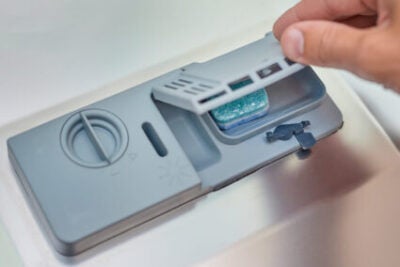
When it comes to tasks and chores, he has adult rituals to assist him call up to complete them. For example, if he empties the dishwasher, he immediately puts soap in it when it'due south empty. Otherwise, he would forget and run it later without putting in the soap.
He has similar means of reminding himself to accept his medication or call up appointments. For annihilation related to an appointment or a job that must be washed at a specific time, he adds them to his telephone agenda with an alarm to brand sure he doesn't forget.
No matter what happens in a 24-hour interval, Evan tries to keep his challenges and mistakes in perspective. "A patient in rehab with me used to ask herself the question 'Are my mistakes deadly? Are they fatal?'" he reflects. "If the answer is no, then while you don't similar making them, y'all demand to keep it in perspective."
The Challenge of Invisible Disease
"So many people struggle with invisible diseases and weather," Dr. Cohn points out. "A person who has a broken leg is piece of cake to encounter. But psychiatric diseases, cancer, brain injuries – in those cases, you don't know what people are going through. Their struggles might not leave a visible mark."
The invisibility of what Dr. Cohn experiences is an extra challenge. "I may wait normal," he says, "simply y'all don't see the corporeality of piece of work that it takes me to await that way."
Friends and acquaintances are well-intentioned and accept been a tremendous source of support and comfort over the past six years. But sometimes they don't empathise what is helpful for someone in Dr. Cohn's shoes to hear.
"As a encephalon injury survivor, we don't want to hear 'Nosotros all forget things,'" he says. "It makes you lot have to recall all the worst mistakes y'all've made. This isn't normal crumbling. I hear them wanting to connect, but it'southward not the same matter."

Instead, he finds simple gestures, similar adding him to prayer lists, lighting a candle, or offer thoughts and prayers, most impactful. "I used to think those things were kind of cheesy, simply now I feel they are very squeamish things to say," he says. "Peculiarly when I know that the person really means it."
People understanding his limitations and mistakes makes a huge deviation, every bit is knowing that people are glad to have him around and don't need him to be perfect. If someone wants to assist, he has found more specific and direct questions most helpful. "'I'grand coming over, what dark can I bring you lot dinner?' is a more than helpful question than 'Let me know how I tin help'" he says.
How Are Yous Doing Today?
A quote from Facebook CFO Sheryl Sandberg has stuck in Evan's mind in the years since his hemorrhage. After the sudden death of her husband in 2015, Sheryl found the standard question people would ask, "How are yous?", to be difficult to answer. She knows they meant well. Simply saying good or fine felt like a lie: afterward all, she was grieving a tremendous loss.
In her volume, Option B, she suggests changing the question slightly, to "How are yous doing today?" She sees this as a way to admit the challenges that someone is facing. But it also acknowledges that they are getting through those challenges, solar day by 24-hour interval. And it reminds them to take things one day at a time. That has been immensely helpful for Dr. Cohn.
The Honey of Family

Above all, Dr. Cohn attributes his connected well-being to the beloved, support and understanding of his family unit – his wife and his daughters.
"My daughters have become much more than patient and understanding of me," he says. "They know that my memory isn't what it used to exist and that I take cognitive deficits."
"My wife has been incredible," he says. "She's patient, working together with me to understand and not pointing out my mistakes all the time. She's then agreement and supportive."
Evan could see a spouse in her shoes being frustrated with him for needing extra help and making mistakes. But that's not how Amy feels. "The style I run across it, I am lucky to have him here, side by side to me," she says.
Dr. Cohn echoes that sentiment. His final takeaway for anyone is his shoes, or anyone with a family member who experienced what he did, is uncomplicated.
"Live life to the fullest."
Source: https://med.virginia.edu/radiology/2021/09/01/living-well-after-surviving-a-subarachnoid-hemorrhage/
0 Response to "Can Bleeding in the Brain Happen Again When You Push Yourself to Hard"
Postar um comentário